________________________________________________________
Sylvia Eckermann
n o w h e r e – ein
welt raum spiel
I treat Wittgenstein's propositions
more like axioms. When I negate the axiom,
'We make ourselves a picture
of the world' and say, 'We make ourselves a world
from a picture' then
I create the whole of Constructivism.* Heinz
von Foerster
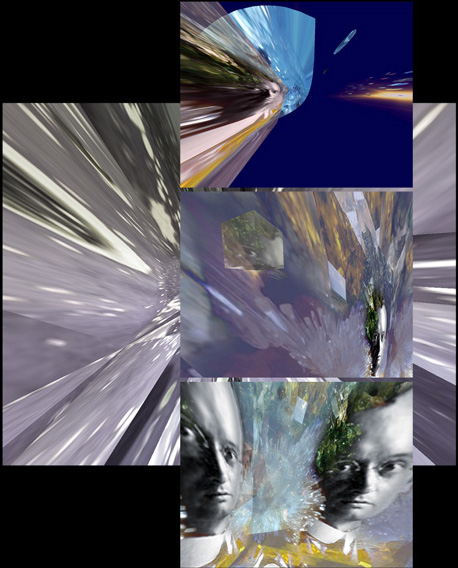
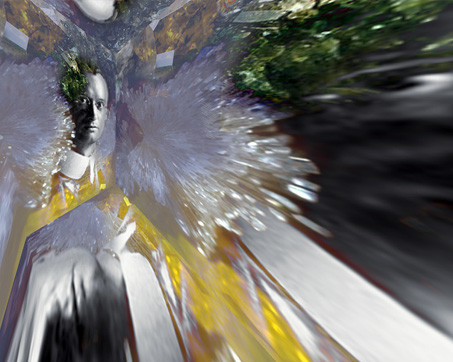
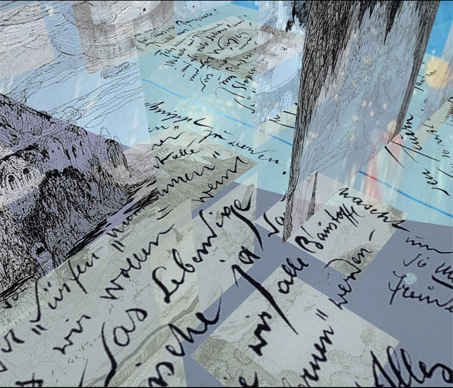
n o w h e r e is a gamemod, a modification
of the Egoshooter Unreal,
in which the player can move freely in any direction
in virtual, three-dimensional space.
Architecture, sounds, spoken text
and pictures support the immersive effect of this medium.
The choice of
free flight through space and time as a metaphor reflects the world of
thought
of the group of artists and architects that came together in the Gläserne Kette (The Crystal Chain)
correspondence [initiated
by Bruno Taut in December 1919] to share ideas.
Mere depiction was not the aim of our work, neither the transfer of the
two-dimensionality
of the sketches, designs and drawings into the third
dimension, but rather the enticement of
the viewer into a "dream
world" of utopian ideas and their simulation. Thus, in n o w h e r
e
Wenzel Hablik's outer-space painting Sternenhimmel [1909] appears
as a dense, sometimes
concave, sometimes convex cosmos of worlds moving
in an unknown system with satellites,
suns, conglomerations of stars,
flying machines and airborne colonies.
Some of these celestial
bodies are
taken from text fragments from Paul Scheerbart's Glasarchitektur, a work by the
man of letters who died in 1915 and who
very much influenced the proponents of
the Gläserne Kette: "Paradise
beetles, lightfish, orchids, shells, pearls, diamonds and so on—
all
of this together is the most magnificent on the surface of the earth—and
this is all to be found
in glass architecture. It is the highest — a
pinnacle of culture." (in: Glass
Architecture, 1914)
A planet cluster beams the visitors, as navigating cosmonauts, into the
contemporary
architecture
shining in many colors quoted by us. "Happiness
without glass—how dumb is that!",
"What would construction
be without reinforced concrete? "These sentences formulated by
Paul
Scheerbart penetrate the consciously fragmented architectural extracts
that appear
like dazzling spots and fade away again.
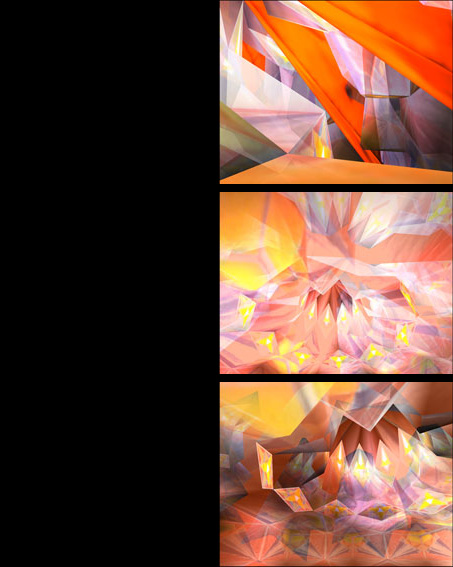
As in all parts of the work n o w h e r e one will also be able to discover
a crystal here,
in whose faceting the cosmos is reflected in its entirety.
This crystal functions as a transition
like a wormhole—as a link
up to the starting point. Crystal, an important form to which not only
our protagonists related, penetrated by light, unifying outside and inside,
simultaneously
form and spirit, an inorganic material growing similarly
to a biological organism, is penetrable
in n o w h e r e — a relationship
of reciprocal transmissions and penetrations of form just as of meaning.
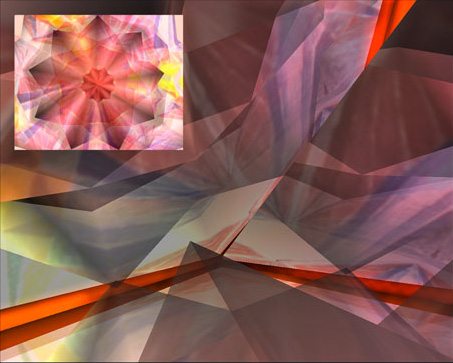
And—as if one were inside a multi-faceted macrocosmos — the polygons
that delineate the inside
become an immersive kaleidoscope.
A particular crystalline form is assigned to Wenzel Hablik, Bruno Taut,
Wassili Luckhardt,
Hermann Finsterlin,
Hans Scharoun and other proponents.
Like a chain, link after link lines
up on invisible threads. They seem
to be enclosed in this form that appeared so important to them —
like
the insect caught up in resin that
has become stone. Where they twinkle
like inclusions in the light
of the stars there are other links and invisible
portals.
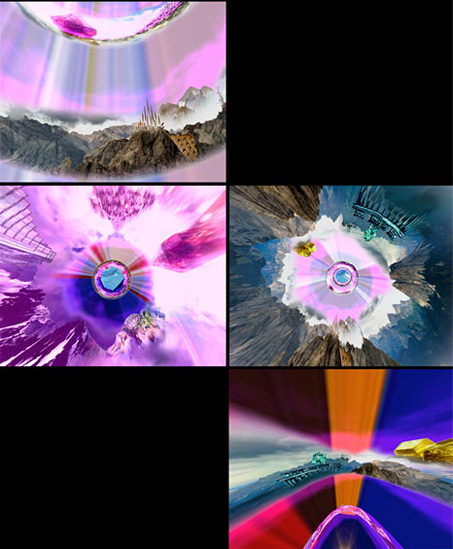
One enters a prismatic lucent cylinder in which mountain panoramas
revolve through fog.
This place
is dedicated to Alpine Architektur [1917-1918] by Bruno Taut, the spokesman of the
Crystal Chain
group
of artists and architects. His drafts become real in the mountain
chains— crystal cavities adorn the
crevasses, chrysocolla, amethyst
and bismuth tower upwards like
futuristic buildings competing with
the mountain tops. Here too, the previously mentioned crystal again
leads back to the cosmos.
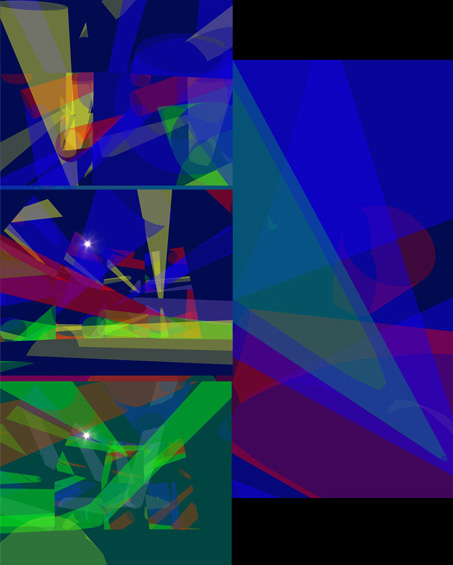
The area dedicated to Wassili Luckhardt does not tell of the vastness
of the starry sky
but of the stronghold of fortress construction.
His designs for buildings of worship [around 1920]
are external views
of crystalline-formed glass architecture that are interpreted as a
possible
interior view in the virtual architecture n o w h e r e.
The sparkle around Wenzel Hablik's crystal is the transition to his Schöpferische Kräfte [Creative Powers]
— a series
of etchings [1912] that tell of the becoming and being of crystal,
of birth, becoming and death.
The cosmonaut — the visitor — in
n o w h e r e will be able to discover this and much more as he flies
on his
freely chosen path through the cosmos of the Gläserne
Kette.
Come and see Utopia and start out from n o w h e r e !
|